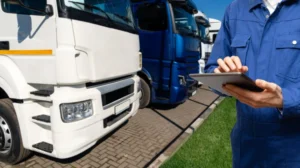
As a fundamental part of the Australian economy, it is not difficult to see how the transport and logistics industry has been severely impacted by the COVID-19 pandemic, which was only exacerbated by the already existing variance in regulatory regimes across each of the states and territories. It became obvious quite quickly as to how incompatible the Australian government’s travel restrictions were for an industry fundamentally based on travel and movement of people and products.
Impact on the Australian Transport and Logistics Industry
To give you some context, Fiftyfive5 a strategy consultant reported that no less than 93% of Australian truck-based operations suffered an impact on their business as a result of the pandemic and public health measures. It was reported by the Freight & Trade Alliance that approximately 300,000 containers would accumulate at Australian wharves and prevent the unpacking and distribution of goods due to movement restrictions. [1] Leading supermarket chains Coles and Woolworths postponed home delivery to most consumers, despite the demand for groceries and other goods increasing by 40% during lockdown.[2] Delays were evident where Qantas was required to close its freight terminals due to the virus spreading amongst workers. [3]
Australian Government Management Strategies
Only in July was there welcomed relief by the transport and logistics industry when the National Cabinet agreed to a Freight Movement Protocol alongside the Freight Movement Code (‘Code’) aimed at implementing greater consistency in border control compliance and enforcement measures in each state and territory particularly in relation to COVID-19 testing, contact tracing, personal protective equipment and effective self-isolation for freight operators crossing borders.
With respect to NSW freight, transport and logistics workers moving across the borders, the Code set out the following enforceable measures:[4]
- Requirement for a valid border permit or equivalent approval (if your employer has a Covid-19 Safe Workplan – self-isolation is not required when crossing the border from NSW to Victoria for work purposes);
- Mandatory COVID Safe Workplan required for all freight operators. As of 12 October 2020, in practice, mutual recognition of these plans across the states occurs in New South Wales, Queensland, Western Australia, South Australia, Tasmania and the Australian Capital Territory. Transport operators are encouraged to become COVID Accredited when COVID Safe Workplans include additional measures such as daily health screening for freight workers, regular testing on a rolling 7-day basis for freight workers facilitated by the freight operator;
- A requirement to carry and use COVID-19 related Personal Protective Equipment such as an appropriate face mask, hand sanitiser and gloves;
- Testing for asymptomatic freight workers to be voluntary (not mandatory) but encouraged on a rolling 7 day basis;
- Record keeping for contact tracing purposes to be kept and maintained;
- Effective isolation where practicable when working during stops, including for accommodation purposes;
- No passengers, unless required for the purposes of work (for example, two-up drivers);
- No working while symptomatic until a negative test result has been received.
These new measures are also enforceable, and evidence will be required to be shown to an authorised officer to ensure compliance with the above. The penalties that apply are based on each state and territories Public Health Orders and/or Emergency Management Directions.
If you require assistance with any of the above, please do not hesitate to contact a member of Coleman Greig’s Commercial Advice Team who would be more than happy to assist you today.